Assessment of transition metal-doped Zinc Oxide nanoparticle for ions trapping: bridging structural and electronic insights by DFT optimization
DOI:
10.1980/jses.v1i1.15Published:
2026-06-19Downloads
Abstract
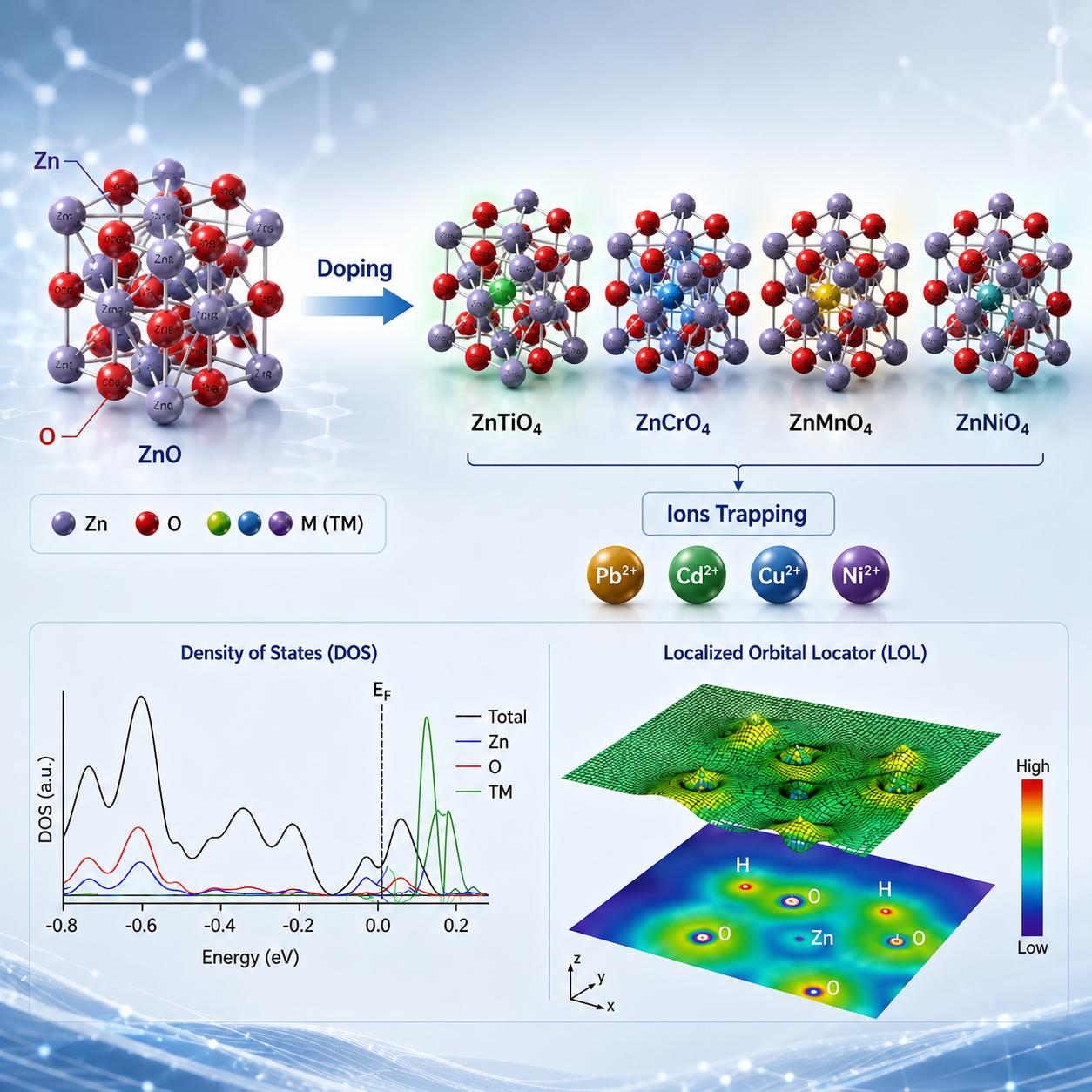
A detailed study was performed using "DFT" calculations at the "CAM-B3LYP-D3/6-311+G (d,p)" level to investigate how H2O is captured by a ZnO, ZnTiO, ZnCrO, ZnMnO or ZnNiO heterocluster. The weak signal strength observed near the parallel edge of the nanocluster sample could be because of the non-spherical arrangement of these heteroclusters caused by H/OH binding. This hypothesis about energy absorption was supported by analyzing the density distributions of "TDOS, PDOS, OPDOS, LOL" for water-coated ZnO, ZnTiO, ZnCrO, ZnMnO and ZnNiO heteroclusters. An isosurface map showed a larger area involved in H2O adsorption on the surface, leading to the formation of hydrated complexes of ZnO-(H+OH-), ZnTiO-(H+OH-), ZnCrO-(H+OH-), ZnMnO-(H+OH-) and ZnNiO-(H+OH-) with specific atoms labeled as "O1, Zn/Ti/Cr/Mn/Ni, O27, H29, and H30". Based on this, it could be said that the Zn/Ti/Cr/Mn/Ni in the cubic heteroclusters, respectively has a greater ability to accept electrons during H2O adsorption. It's also important to note that when all the surface elements of these heteroclusters are covered by "OH–/H+" ions, the semiconducting treatment is restored. These findings suggest that the electronic properties can be adjusted by controlling the adsorption position on the surface. The findings can potentially lead to the development of more efficient water purification processes through further research on photocatalysts.