Molecular insights into the corrosion inhibition performance of Sclerocarya birrea leaf phytochemicals on aluminum: a combined DFT and Monte Carlo simulation study
DOI:
10.1980/jses.v1i1.5Published:
2026-06-19Downloads
Abstract
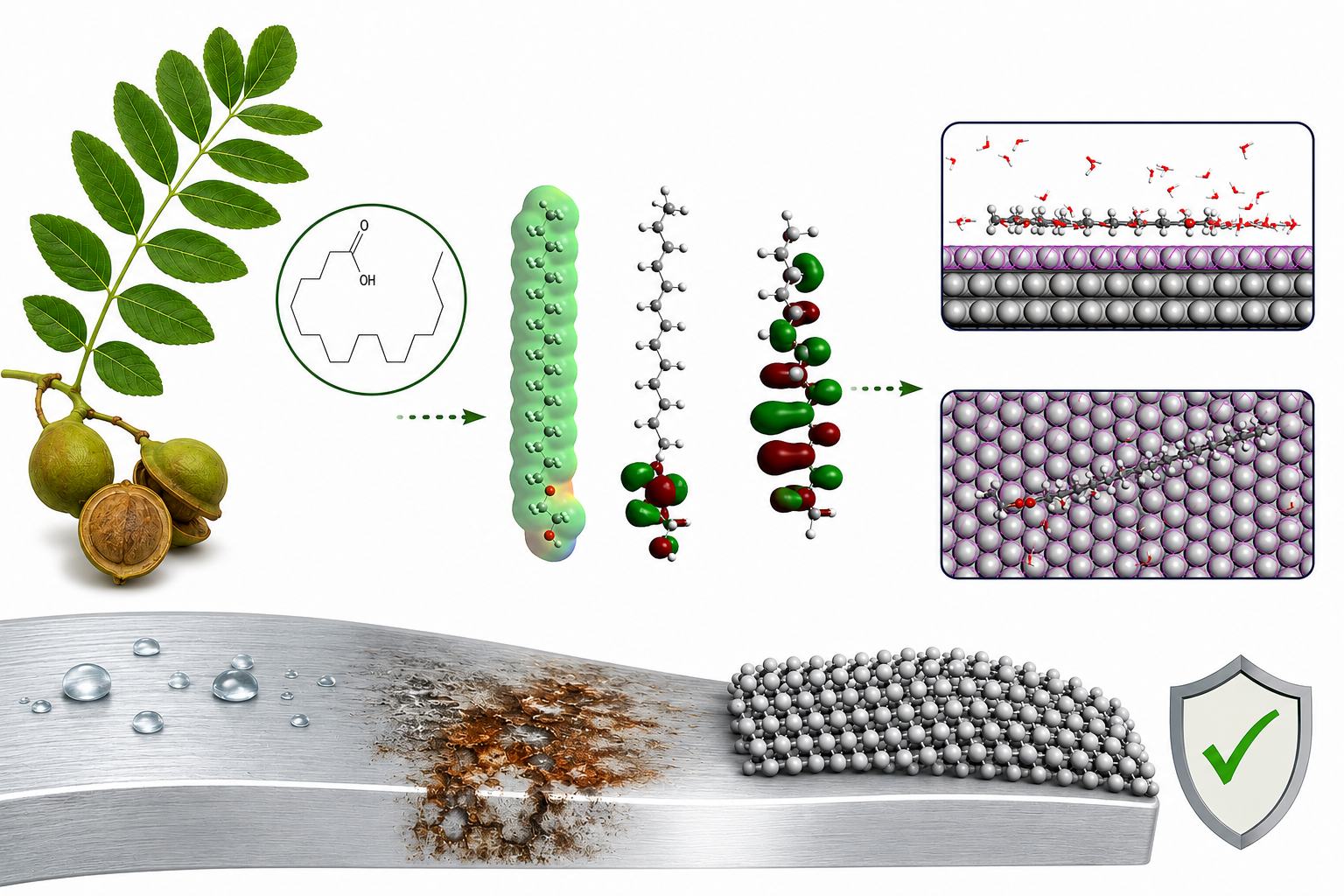
This work presents a multiscale computational investigation of selected bioactive derivatives obtained from the ethanolic leaf extract of Sclerocarya birrea as prospective green corrosion inhibitors for aluminum in aqueous environments. Four major constituents—Ethanol,2-(octadecyloxy) (T1), Hexadecanoic acid ethyl ester (T2), Octadecanoic acid ethyl ester (T3), and Octadecanoid acid (T4)—were systematically analyzed using Density Functional Theory (DFT) and ab initio methods to evaluate their electronic reactivity and inhibition potential. Key global reactivity descriptors, including frontier molecular orbital energies (EHOMO, ELUMO), energy gap (ΔE), ionization potential, electron affinity, electronegativity, global hardness, and fraction of electron transfer (ΔN), were computed to establish structure–activity relationships.To elucidate the interfacial adsorption behavior and thermodynamic stability, Monte Carlo simulations were performed on the aluminum surface. The adsorption configurations and binding energies reveal strong surface affinity governed by electron-donating capability and molecular size. Among the investigated compounds, T1 demonstrates the most favorable electronic parameters, the smallest energy gap, and the highest adsorption energy, indicating superior inhibitory performance. The predicted inhibition efficiency follows the order T1 > T3 > T2 > T4, which correlates consistently with both quantum descriptors and adsorption energetics. The integrated quantum–statistical simulation framework confirms that corrosion inhibition efficiency can be reliably predicted through theoretical modeling without experimental input. These findings highlight the potential of Sclerocarya birrea-derived molecules as sustainable corrosion inhibitors and demonstrate the robustness of computational simulation as a predictive tool for rational inhibitor design in engineering applications.