Computational investigation of aza-18-crown-6 derivatives as iron corrosion inhibitors
DOI:
10.1980/jses.v1i1.2Published:
2026-06-19Downloads
Abstract
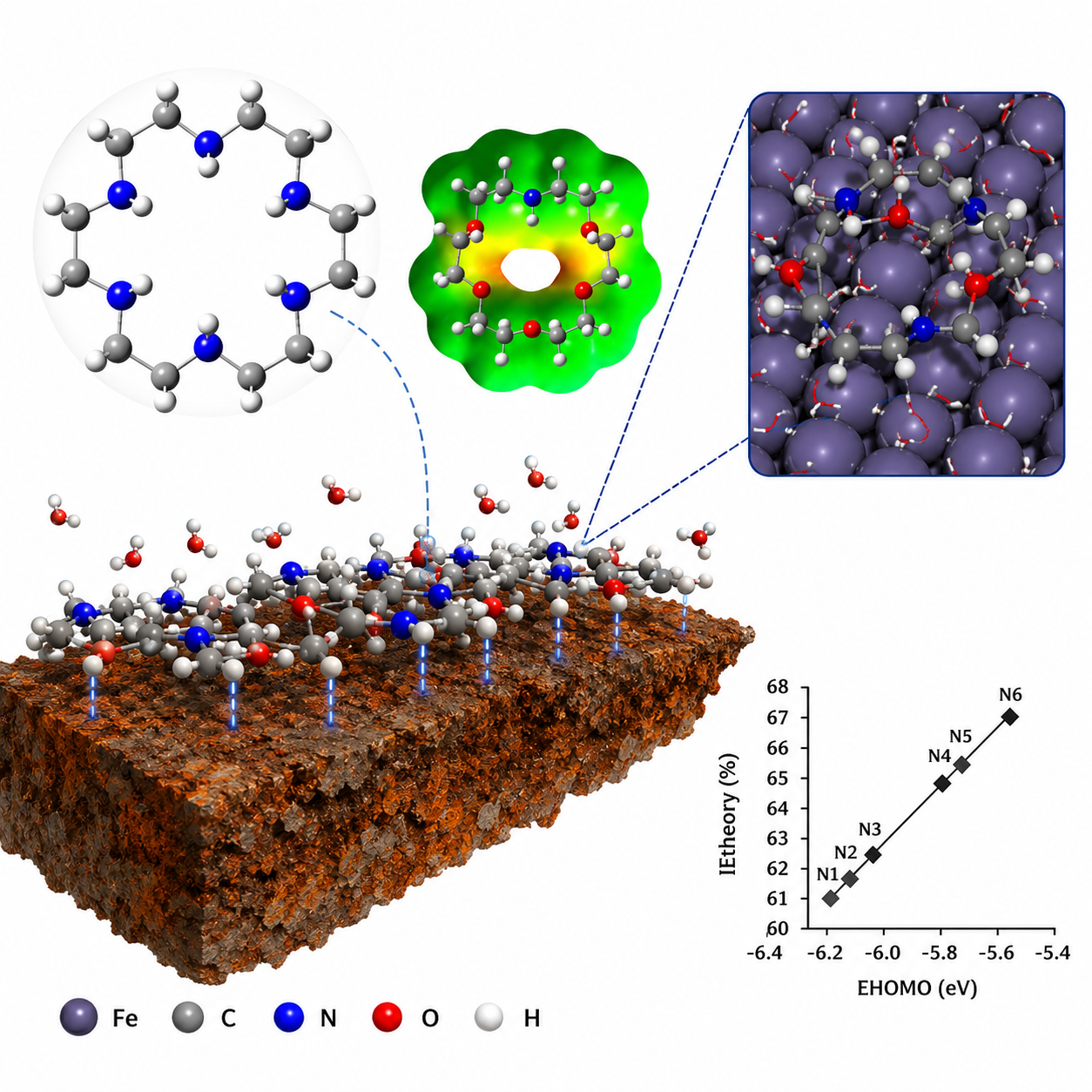
The effect of changes in the number of nitrogen atoms on the corrosion inhibition efficiency of 1,4,7,10,16-Pentaoxa-13-azacyclooctadecane (aza-18-crown-6/N1) derivatives has been studied using Density Functional Theory and Monte Carlo Simulation. The DFT B3LYP/6-311G(d,p) method was used to measure the quantum parameters of aza-18-crown-6 derivatives. Prediction of corrosion inhibition efficiency based on quantum parameters is successively hexaaza-18-crown-6 (N6) > pentaaza-18-crown-6 (N5) > tetraaza-18-crown-6 (N4) > triaza-18-crown-6 (N3) > 1,4,10,13-diaza-18-crown-6 (N2) > aza-18-crown-6 (N1). N6 has the highest inhibition efficiency, while N1 has the lowest. The substitution of a nitrogen atom into the crown ether ring acts as an electron donor. Monte Carlo simulations demonstrate the interaction of aza-18-crown-6 derivatives with the iron surface. This indicates good agreement with the results obtained from DFT/B3LYP 6-311G (d,p) quantum calculations in the solution phase.